
Your Golden Visa Fund's Tax Statement Probably Isn't Going to Preserve Capital Gains Rates. Claim A Refund For Past Years While You Still Can.
If you're a U.S. investor in a Portuguese Golden Visa fund and you previously made a QEF election and paid phantom income tax, you may have significantly overpaid federal income tax and risk losing it
The problem no one is talking about
Every year, Portuguese Golden Visa funds provide U.S. investors with a PFIC Annual Information Statement (AIS) so they can make a Qualified Electing Fund (QEF) election on IRS Form 8621. Investors DIY their filings or hand this document to their CPAs, who use it to calculate how much tax is owed. It appears that everyone assumes the statement is correct because everyone assumes it was someone else’s job to ensure the statement is correct. Fund managers assume auditors have done so. Auditors assume fund managers have done so. Investors assume the fund managers and the auditors have done so. Tax pros assume investors and fund managers have done so. The IRS requires that taxpayers have done so. No one has done so.
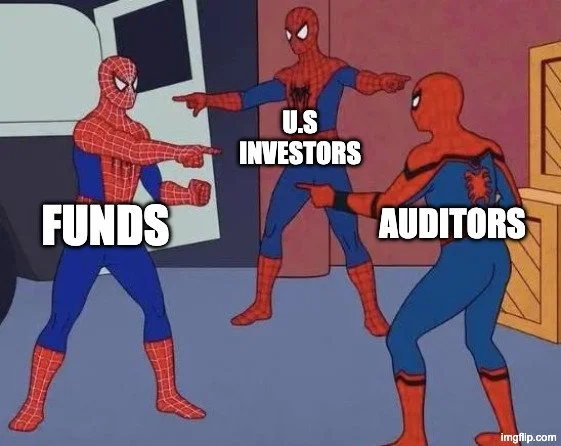
Three spider men pointing at each other. One marked “Funds.” One marked “Auditors.” One marked “U.S. Investors.”
The regulatory standard is set by Treasury Regulation § 1.1295-1(g)(1). It requires that a PFIC Annual Information Statement provide each shareholder’s pro rata share of ordinary earnings and net capital gain, determined under U.S. tax principles. I’ve spent the past several months researching this extensively. I have forensically analyzed the PFIC Annual Information Statements produced by Portuguese fund managers. Among the statements I have examined to date, while some appear facially correct, none satisfy the regulatory requirements under U.S. tax law.
The structural deficiencies are far more than a matter of minor imprecision or rounding differences. They affect how income is categorized, how gains are characterized, and whether the numbers flowing onto Form 8621 bear any reliable relationship to what U.S. tax law actually requires.
What this means for a U.S. tax position
If the PFIC AIS underlying a QEF election does not satisfy § 1.1295-1(g), the validity of that election is vulnerable. A materially non-compliant statement creates serious risk that the election may not hold. And if the election is ineffective, every dollar of tax paid under it was paid under a regime that does not apply and will not be credited toward the tax regime that does apply. The IRS doesn’t net that out.
That tax is reclaimable, but only within the three-year refund statute under § 6511.
Last call for tax year 2022 investors to reclaim those tax payments!

A pile of U.S. hundred dollar bills on fire.
Let’s explore a real example. In pressure-testing a particular 2023 vintage PFIC AIS based on public data, I identified three distinct categories of investor impact:
Some investors overpaid by a substantial amount, tens of thousands of dollars per year, because the statement caused income to be reported that doesn’t exist under U.S. tax principles.
Some investors overpaid by a moderate amount because they or their CPAs caught part of the problem but were unclear on how the statement characterized certain figures.
And some investors may have landed close to what appeared to be the right figure, but it ultimately doesn’t matter, because the AIS that their QEF election rests on is structurally non-compliant. The legal vulnerability is the same. Their overpaid tax, while perhaps at a lower amount, is just as reclaimable. Their exposure if they do nothing is just as real.
Depending on how a fund is structured, investors may have additional reporting obligations beyond a single Form 8621 for the fund.
Beyond the PFIC question, some U.S. investors in Portuguese Golden Visa funds may also be U.S. Shareholders of Controlled Foreign Corporations without knowing it. That triggers Form 5471 filing obligations. The penalty framework includes a $10,000 base penalty per failure, plus continuation penalties of up to $50,000 per return, for potential exposure of up to $60,000 per filing failure. Fund structures could expose investors to more than one Form 5471 requirement in any given tax year. Interest on assessed penalties accrues as required by statute. These are not theoretical numbers. Most investors in these funds have never been told to evaluate whether CFC reporting obligations apply to them. Hi. It’s me. I’m telling you. This is serious.
The § 1291 trap, and why the math escalates
If a QEF election is ineffective, the investment does not have QEF treatment. It has § 1291 excess distribution treatment by default. Tax previously paid under QEF rules does not automatically credit against a § 1291 recomputation. If the three-year refund statute under § 6511 has closed, those QEF tax payments may be economically unrecoverable, and tax will still be owed under § 1291 at exit from the fund.
Excess distribution treatment is punitive by design. The gain on exit gets allocated ratably across every year of the investment holding period. Each prior year’s allocation is taxed at the highest marginal rate for that year, currently 37%, regardless of any investor’s own tax bracket. Daily compounding interest is added, per § 6621, from the due date of each prior year’s return. For six- to eight-year holding periods, which are typical in this market, the effective tax rate under § 1291 can reach 55% or more.
That’s rough, and I know no one wants that.
And yet, it could get worse. Consider an investor who dutifully paid tax under a QEF election, let’s say at 24% or 32% on ordinary income and 15% on capital gains, based on their adjusted gross income and the fund’s PFIC AIS. If that QEF election is invalidated and the three-year refund window has closed, the early years of QEF tax payments are lost. The investor doesn’t get credit for them. They paid tax under a regime that was not applicable, and they still owe the full § 1291 excess distribution amount at the 37% rate plus compounding interest.
Now layer in penalties. The Internal Revenue Code provides for a 20% penalty for substantial tax understatement under § 6662(d). Where the understatement relates to undisclosed foreign financial assets, § 6662(j) increases that to 40%. Many Portuguese fund structures contain subsidiary investment vehicles and SPVs, through which the fund deploys capital, that might require separate reporting, and that investors were never told to report separately. If those lower-tier interests that require separate reporting went undisclosed, § 6662(j) could apply.
The applicable category depends on the specific facts, however it is not far fetched for some Golden Visa fund portfolio assets to require separate reporting, go unreported, and have associated gains be subject to: 37% income tax, daily compounding interest, and a 40% underpayment penalty. For an unreported asset that delivered the equivalent of $50,000 in gains over a seven year holding period, a ballpark estimate is:
$50k x 37% = $18,500 tax due
plus daily compounding interest over 7 years = $18,500 + $9,655 = $28,155
plus a 40% underpayment penalty: $18,500 × 40% = $7,400.
Total estimated exposure: $28,155 + $7,400 = $35,555
That’s roughly 71% of the original $50,000 gain eaten by tax, interest, and underpayment penalties. And that’s on a single unreported asset within one fund, before considering missed filing-related penalties (FBAR, 5471, 8938, etc.) which start at $10,000 per missed form per year. Let’s assume only one missed form type, assessed at $10,000 for each year (six missed years, so $60,000) without escalating continuation penalties. That brings the total IRS outflow to $95,555 of $50,000, nearly twice the value of the gain itself, before considering the tax preparation costs or taxes paid but lost to the statute of limitations.
Run the numbers on a typical Golden Visa investment over several years: forfeited QEF tax, plus § 1291 recomputation at the highest marginal rate, plus daily compounding interest, plus potential accuracy-related penalties. When modeled over a typical Golden Visa holding period, total economic impact can approach or exceed 80% of investment gain. Filing penalties can push that beyond 100% of gain.
And that refund window under § 6511? It's the same clock that determines recovery of QEF taxes that were overpaid in earlier years. Every dollar of exposure in that example is a dollar that could potentially be offset with a timely refund claim. Wait too long, and the full amount will apply with no credit for what was already paid.
I don't want any of this to be true. Yet, it is. And I feel a moral obligation to shout it from the rooftops.
Penalties, duty of inquiry, and scrutiny risk
It gets worse still. Not knowing is unlikely to provide penalty relief. Investors with filing deficiencies related to offshore investments have a more narrow case for reasonable cause with the IRS. The IRS’s own guidance reflects this in IRM 20.1.9.1.5, which guides the assessment of penalties and interest associated with international filings. Reasonable cause is defined in item (4):
“Reasonable cause applies to most, but not all, penalties. However, taxpayers who conduct business or transactions offshore or in foreign countries have a responsibility to exercise ordinary business care and prudence in determining their filing obligations and other requirements. It is not reasonable or prudent for taxpayers to have no knowledge of, or to solely rely on others for, the tax treatment of international transactions.”
It goes on to stipulate:
“Because of the unique nature and risks associated with international transactions, reasonable cause should not be granted to a taxpayer merely because of the following:
1) A foreign country would impose penalties on them for disclosing the required information,
2) A foreign trustee refuses to provide them information for any other reason, including difficulty in producing the required information or provisions in the trust instrument that prevent the disclosure of required information, or
3) The taxpayer relied on another person to file returns. It is the taxpayer’s responsibility to ensure that all returns are filed timely and accurately.”
This language positions the IRS to reject reasonable cause arguments from any taxpayer who invested offshore without independently determining their U.S. filing obligations, regardless of what they were told by fund managers, migration agents, or foreign advisors.
The window is closing, in two ways
Most U.S. investors in these funds are extension filers. The funds don’t release PFIC AIS documents until April, sometimes May or later. No one can file an accurate 8621 without the AIS, so extensions are common.
That means a three-year refund window under § 6511 runs from the original filing date (likely after April 15), or two years from the date of payment, whichever is later. For tax year 2022 returns, the refund claim deadline is approaching fast. For earlier years, it may already be gone. Investors who joined funds in 2023, 2024, 2025 would be wise to clarify tax exposure and reclaim overpayments now.
There’s a second clock running. When investors file amended returns claiming defective QEF-related overpayment refunds with multiple amended Forms 8621, all referencing the same fund, the same PFIC AIS, and the same deficiency, a pattern will be created that the IRS can see. It’s exactly the kind of cluster that could draw scrutiny to the fund’s entire U.S. investor base.
The investors who move first recover their money and create compliance narratives. Those who wait may find the narrative constructed for them.
This isn’t a DIY project
I will be direct: investors may not be able to diagnose this for themselves, and unless their CPAs have deep expertise in PFIC compliance, CFC rules, Portuguese fund accounting, and the specific ways these AIS documents fail to meet U.S. regulatory requirements, they might not have the answers here.
The funds themselves probably can’t help very much with this exploration either. They disclaim any ability to provide U.S. tax advice, and that is sound. From what I can see in the market, there is a widespread lack of understanding of U.S. tax impact that results from investments in the funds. And while it is hard to imagine that fund managers would still lack clear U.S. tax guidance in a market that has become dominated by U.S. investors in the past few years, nevertheless here we are. From what I have seen, the accounting firms that may have prepared the fund manager-issued PFIC AIS don’t seem to be working from U.S. tax principles in the first place. It appears that everyone thinks this is someone else’s problem. Still, the IRS thinks it’s yours.
It breaks my heart. It might break your bank account. I’d like to help you. Through my practice at PFICHelp.com, I investigate across tax, securities, custody, and cross-border operations to map failure points at the boundaries between systems.
There is another path, but it’s narrow
Beyond working with me for a forensic tax exposure diagnostic, which includes verifying the accuracy of a PFIC AIS, there is one other option: a retroactive QEF election with compliant data and an affidavit demonstrating faulty advice by a tax professional.
Earlier this year, the IRS issued Rev. Proc. 2026-10, which provides a standardized process for requesting a Private Letter Ruling to make a retroactive QEF election under § 1295(b). An investor whose prior election is determined to be ineffective may be able to use this procedure to establish a valid QEF election, though the scope of relief available in that specific scenario is not fully settled.
It may work, particularly for investors with exposure to multiple PFICs. But first they need to know what was wrong with the QEF election, and they need compliant data to replace the faulty data. They also need:
$43,700 (reduced fees may be available depending on income level)
attorney fees for the Private Letter Ruling (PLR)
a detailed affidavit establishing reasonable reliance on qualified tax advice.
Fund manager assurances do not qualify as professional tax advice under the regulation, but CPA guidance does. If a CPA relied on the fund’s defective AIS to prepare a U.S. tax return and advise the QEF election, that may provide the factual basis for the affidavit. Where a return was prepared based solely on fund-provided data without independent verification, that fact pattern may itself become part of the IRS’s review.
Rev. Proc. 2026-10 also permits bundling of “substantially identical” ruling requests at reduced fees, which could be relevant for investors in the same fund facing the same CFC exposure or PFIC AIS deficiency. I offer a free investor registry at PFICHelp.com so you can find each other to collaborate on remediation.
For some investors, especially those for whom a PLR is out of reach due to lack of proof of faulty tax advice, reclaiming QEF overpayments and getting properly positioned under § 1291 could be more cost-effective than the PLR route. But the retroactive QEF option exists, and for investors with larger positions or more complex fact patterns, it may be worth exploring.
What you should consider now
If you’re a U.S. person holding participation/subscription units in a Portuguese Golden Visa fund and you’ve been filing Form 8621 with a QEF election, I want to convey three things:
Fund manager-provided AIS are almost certainly non-compliant with statutory U.S. requirements. This is not unique to one fund. It appears to be a structural issue across the Portuguese fund management industry.
The refund window on the earliest tax years is closing. Once the three-year statute of limitations expires, overpaid tax is forfeited. Last call for tax year 2022!
Doing nothing is not a neutral choice. It means forfeiting refunds, maintaining defective filings, and being unprepared when IRS attention reaches a fund’s investor base, the likelihood for which increases once amended returns start landing.
How I can help
My practice, PFICHelp.com, provides forensic diagnostic analysis of U.S. tax exposure for U.S. taxpayers who invested in offshore funds. This includes assessing the compliance and validity of fund-issued PFIC Annual Information Statements. If you have a CPA, I work with your existing CPA. If you need one, I can refer you to a CPA who knows this terrain well.
The diagnostic includes an independent, adversarial review of the fund’s:
Regulatory position
Books and records and portfolio asset financials
Management regulations, financial reports, and portfolio construction
Cap table and individual investor positions within the fund
PFIC Annual Information Statement under § 1.1295-1(g)
The deliverable provides:
Documentation of the analytical basis for any defect determination
Written analysis your CPA can rely upon in preparing amended filings and refund claims
Evidence of documented inquiry and timely corrective action that may be used in defense against willfulness penalties
For many investors, the recoverable overpaid tax substantially exceeds the cost of the diagnostic, in some cases by multiples.
If you want to understand your exposure before the refund window closes or before you file your tax return based on what could be faulty data, reach out through PFICHelp.com.
This article is for informational and educational purposes only and does not constitute tax, legal, or investment advice. Consult with a qualified tax professional regarding your specific situation.