
PFIC AIS Defects
That Cause Capital Loss and Unrecoverable Tax Payments (2026 Guide)
PFIC Annual Information Statement Defects Drive Preventable Losses for U.S. Investors in Golden Visa Offerings
Many Golden Visa funds and holding companies are passive foreign investment companies (PFICs) for U.S. tax purposes. A U.S. investor who wants to make a qualified electing fund (QEF) election on Form 8621 needs a PFIC Annual Information Statement (PFIC AIS) from the issuer (typically a fund manager) each year. The statement tells an investor how much of the PFIC's income to include on their U.S. tax return, and how much of that income is considered ordinary income and how much of it is classified as net capital gain.
The PFIC Annual Information Statements issued in the Golden Visa market can carry many defects. Beyond noncompliant formatting, the primary concern is what the income inclusion figures represent and how they were derived. The second major concern is how those figures are divided between ordinary earnings and net capital gain. Errors in either category can change an investor’s U.S. tax position resulting from the investment in a PFIC, commonly as a Golden Visa fund, startup, or holding company.
Ed: for the sake of ease, I will generally refer to “funds” and “fund managers” throughout this piece although what I describe is equally applicable holding companies, start-ups, and cash heavy businesses that meet the definition of a PFIC and their corresponding managers, also known as "issuers." While I use the term "Golden Visa," the issues I describe can apply to all PFICs including those that are part of other residency-by-investment and citizenship-by-investment programs including the Greek program, the Investor Visa for Italy, the Hungary Guest Investor program, the Cyprus Golden Visa, the Malta Permanent Residence Programme, the UAE Golden Visa, Antigua and Barbuda Citizenship-by-Investment Program, Dominica Citizenship-by-Investment Program, Grenada Citizenship-by-Investment Program, Saint Kitts and Nevis Citizenship-by-Investment Program, and the Saint Lucia Citizenship-by-Investment Program.Table of Contents
An analysis of cross-border tax exposure for U.S. investors in PFICs, detailing why foreign Golden Visa PFIC reporting fails for U.S. taxpayers and the resulting tax harm risks, including inflated tax payments, lost tax payments, and outsized capital loss at exit, focusing on the failures of Mark-to-NAV hybrid reporting and the disconnect between IFRS fund accounting and U.S. tax principles.
A Qualified Electing Fund (QEF) election on Form 8621 is designed to align the U.S. tax treatment of foreign corporations — funds, holding companies, some startups — with domestic corporations. While the foreign corporation
An investor in a PFIC with a QEF election includes their pro rata share of actual, realized fund earnings on their annual tax return. In exchange, growth at exit is taxed at long-term capital gain rates rather than subjected to the somewhat penalizing default PFIC excess distribution rules governed by IRC § 1291.
In the Golden Visa market, the PFIC Annual Information Statements provided by managers frequently rely on net asset value (NAV) movements calculated under International Financial Reporting Standards (IFRS) rather than U.S. tax principles. These two accounting systems do not align. The mismatch creates two distinct defects:
Phantom Income on Paper Value Gains: Instead of reporting realized profit, statements report unrealized paper mark-ups as taxable income. Investors pay tax on paper growth each year, driving up tax basis. When NAV drops, basis remains locked at its high point, converting investor capital into a capital loss at exit. The capital loss figure can be high enough to make it difficult to absorb in full during an investor’s lifetime.
Unsubstantiated Capital Gain Characterization: PFIC Annual Information Statements split income inclusion figures into ordinary earnings and net capital gain. On a NAV-driven PFIC AIS, this split is often made without performing the position-by-position § 1222 netting required by U.S. tax law, leaving returns filed by taxpayers vulnerable under IRS examination and the U.S. taxes paid on income inclusions by the investors somewhat arbitrary.
While IRS audit rates may be historically low, the financial harm of NAV-based PFIC AIS income inclusions does not rely on an audit to cause taxpayer harm. The harm is mechanical and can accumulate unnoticed over years as investors pay annual income tax on unrealized gains, likely pay the wrong tax rate on some portion of those gains, and track an adjusted tax basis that may be too high to recover in full. If audited, the investors risk QEF election invalidation which would lead to excess distribution tax treatment, readjustment of tax basis back down, and the possible loss of all prior tax payments to the § 6511 statute of limitations for refund claims. It’s not a stretch to reach six-figure losses, all told.
Intended QEF Mechanics vs. Golden Visa Market Reality
What a PFIC Annual Information Statement Must Report for Compliant QEF Elections and Maintenance on IRS Form 8621
Under Treas. Reg. § 1.1295-1(g), the statement provides the investor’s pro rata share of two figures for the fund's tax year.
Ordinary earnings are taxed at ordinary income rates, up to 37%.
Net capital gain is taxed at long-term capital gain rates, up to 20%.
Investors report both in Part III of Form 8621 whether or not the fund made any payments to the investors. The total sum of the income inclusions raises the investor's tax basis in the units. The fund manager must also offer, in writing on the PFIC AIS, to permit investors to inspect its books to confirm the figures were computed under U.S. income tax principles. While I’ve seen this clause included on numerous PFIC AIS, I have never had a fund manager meet an investor’s books and records request with fast, unequivocal access.

Major Defect One:
How IFRS Mark-to-NAV Reporting Inflates PFIC Tax Basis
QEF income inclusions must represent realized Earnings and Profits
QEF income inclusions are based on the investor's pro rata share of the fund's earnings and profits, computed under U.S. federal income tax principles. The computation generally distinguishes taxable realized income and gains from unrealized changes in value, subject to the specific rules governing earnings and profits.
How Mark-to-NAV PFIC Annual Information Statements cause investors to erroneously pay tax on unrealized paper gains
A Mark-to-NAV PFIC statement is an information statement that uses IFRS net asset value growth as taxable QEF income.
Many Portuguese Golden Visa funds report under IFRS and carry their holdings at fair value. Their net asset value (NAV) and share values rise and fall with paper gains on assets the fund still holds. When the PFIC AIS figure tracks NAV growth, U.S. taxpayers are taxed on unrealized appreciation. I call this the Mark-to-NAV QEF chimera.
Every QEF inclusion raises the investor's tax basis in the fund units. When inclusions track NAV, basis climbs with each unrealized value gain the fund manager reports as an income inclusion on the PFIC AIS. When NAV falls, adjusted basis stays at its high point. In this way, adjusted tax basis, meant to reflect principal plus income inclusions based on realized earnings, separates from the reality of the fund's income and value.
Phantom QEF income inclusions inflate tax payments and tax basis
Investors make the QEF election to protect access to capital gain rates on growth captured at exit. Under a Mark-to-NAV statement, that growth is taxed year by year as it appears, well before it is captured, at the rates the statement assigns: either ordinary income or capital gains. By exit, basis has absorbed all growth, both real and uncaptured. The capital gain rate applies only to what is left after the final year's inclusion, which is usually little or nothing. The QEF election becomes a bet that exit value will exceed everything already taxed. For investors in funds where the PFIC AIS is based on unrealized value growth, that bet is unlikely to pay off.
The exit “capital” gain QEF is meant to protect has already been taxed
Navigating the U.S. tax code for foreign investments requires understanding the distinct mechanics of the three primary PFIC regimes:
The default IRC § 1291 excess distribution regime, which penalizes deferred tax payments with high rates and interest charges),
The IRC § 1293 Qualified Electing Fund (QEF) regime, which taxes annual ordinary earnings and net capital gains based on U.S. earnings and profits principles), and requires supporting PFIC Annual Information Statements.
The IRC § 1296 Mark-to-Market (MtM) regime, which taxes unrealized paper gains annually as ordinary income while allowing corresponding ordinary loss deductions in down years. Note that IRC § 1296 Mark-to-Market is available only if the PFIC is marketable (i.e., regularly traded on a qualified exchange), making it generally unavailable for private Golden Visa funds, startups, and holding companies.
Inclusions in up years, nothing in down years. The worst parts of the three PFIC regimes.
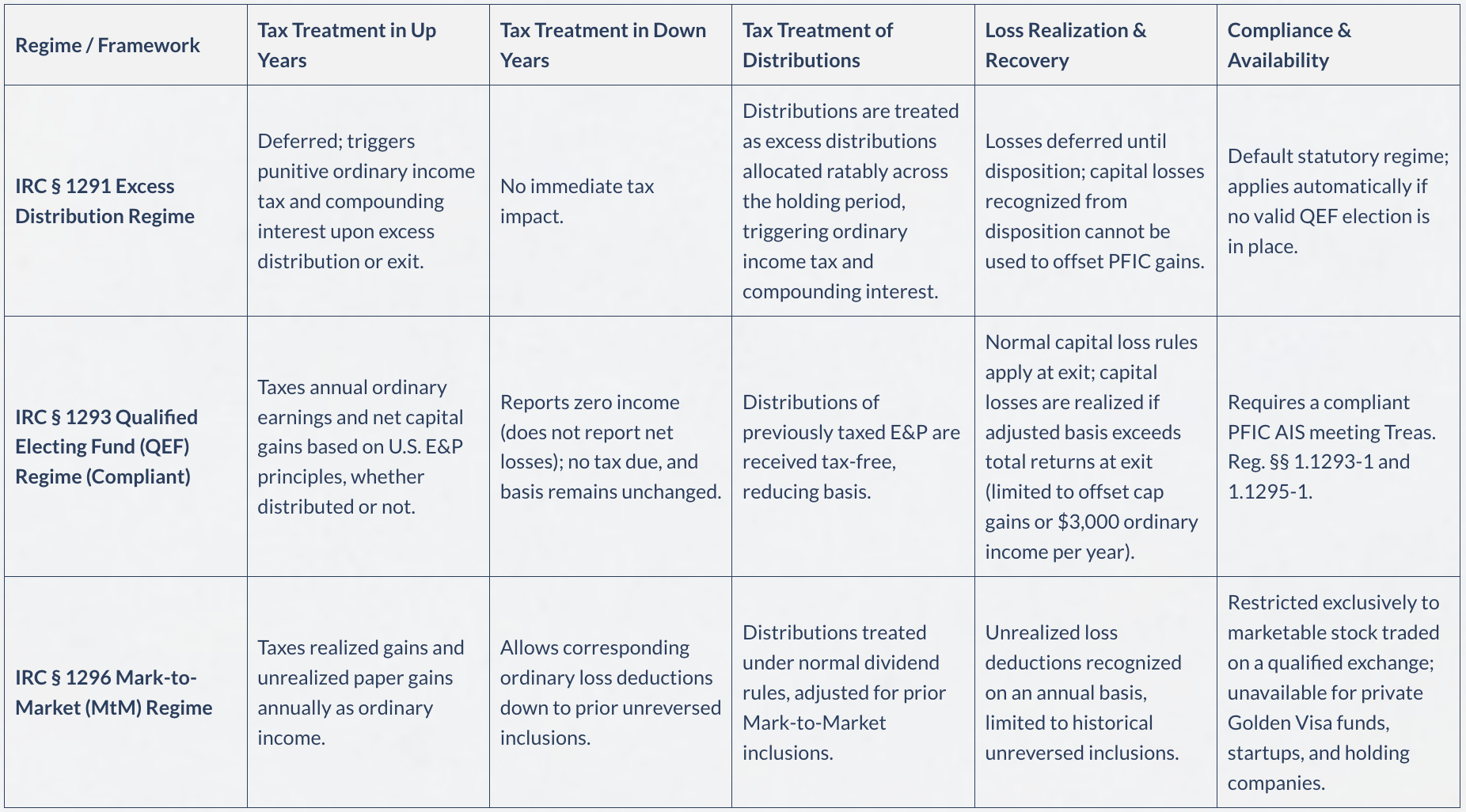
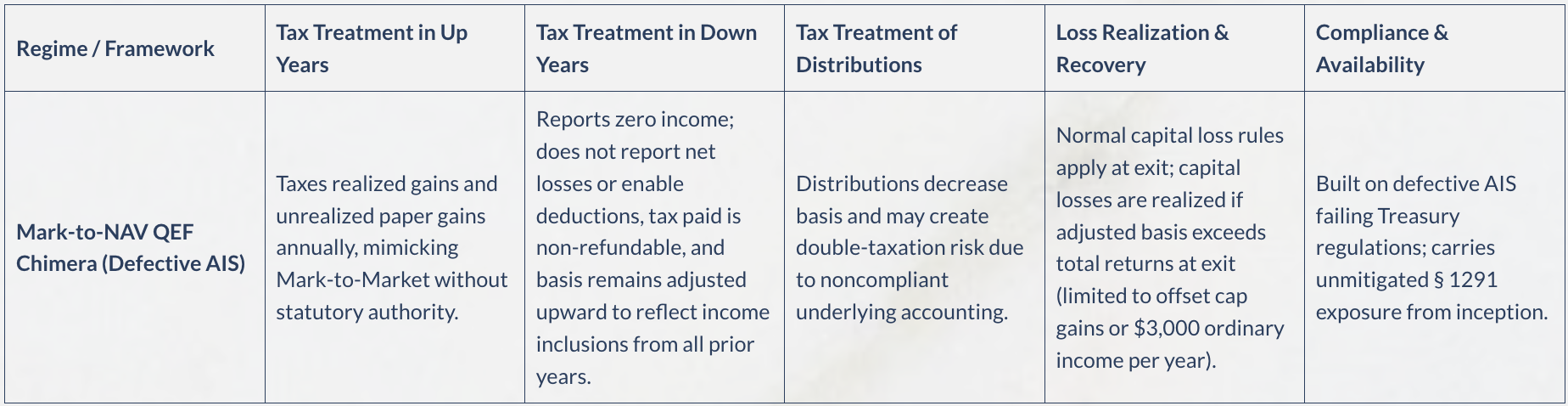
A Mark-to-NAV PFIC statement creates a hybrid, the Mark-to-NAV QEF chimera that belongs to none of the three PFIC regimes.
It taxes paper gains every year, as Mark-to-Market under § 1296 does.
It gives no deduction when NAV falls. Mark-to-Market allows an ordinary deduction in down years, up to the sum of prior income inclusions. A NAV-based PFIC AIS reports zero in a down year, so there are no deductions possible. The tax already paid on income inclusions increases basis but is not refundable, and in a down year, adjusted basis is unchanged.
It locks the loss in until exit, as a capital loss. With no other capital gains to absorb it, a capital loss offsets ordinary income at a mere $3,000 a year. Six-figure capital losses are possible and could outlive the investor, lost to time after the taxpayer’s final tax return is filed.
It carries § 1291 risk the whole time. An election built on a PFIC AIS that fails Treas. Reg. §§ 1.1293-1 and 1.1295-1 may never have been valid and could be corrected in an IRS examination.
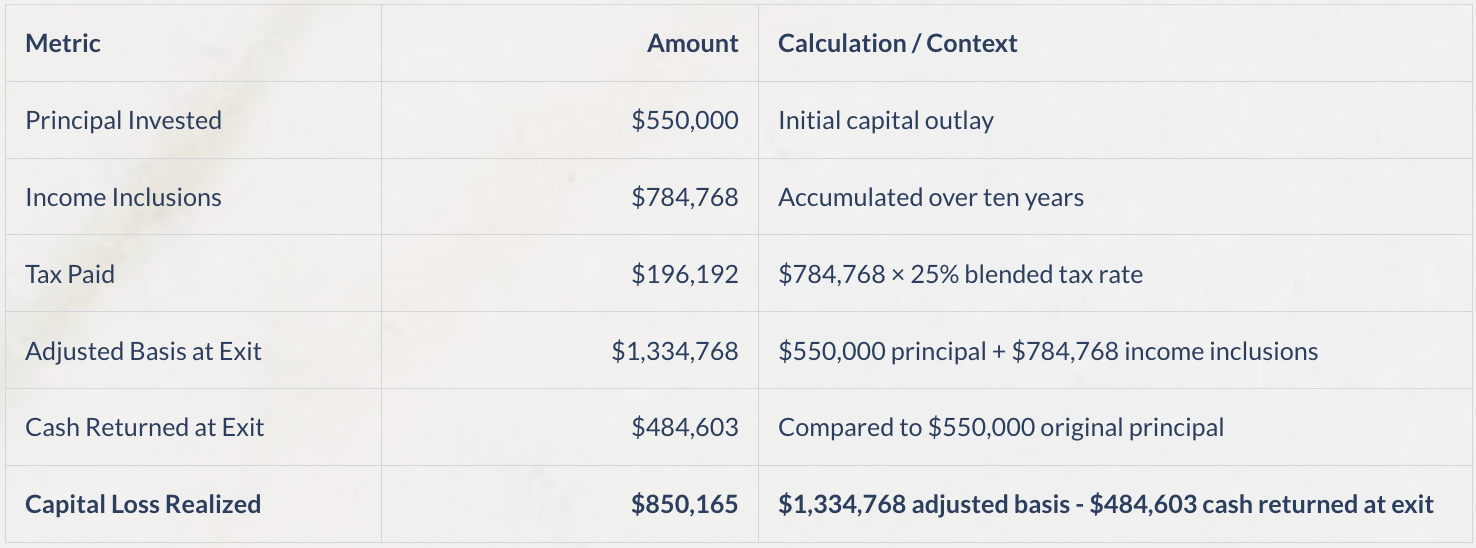
A investor in a fund with a volatile NAV can exit below principal with an adjusted basis far above it
A hypothetical scenario illustrating a Golden Visa capital loss driven by phantom income inclusions on Form 8621 under a QEF election.
Where a U.S. investor subscribes 500,000€ (about $550,000) and holds for ten years in a Golden Visa fund or holding company that has a volatile NAV, alternating between gains of 30% and losses of 25% year-to-year. Each up year produces an inclusion. Each down year produces zero.
In this hypothetical scenario, the fund returned less than the original principal. The investor's economic loss is $65,397, yet they bear a capital loss of $850,165. The difference, $784,768, is attributable to reported income inclusions that never arrived as cash, on which the investor with a QEF election already paid tax. At $3,000 a year, that loss takes more than 280 years to use against ordinary income.
An investor in the same fund with no QEF election would have paid nothing under excess distribution over the decade and would hold a $65,397 economic loss, which is also the total amount of capital loss. The capital loss for an investor taxed under excess distribution reflects the true loss of principal. The investor escapes an inflated capital loss based on income inclusions that reflected unrealized gains.
A yearly QEF inclusion reads like a report of earnings. Under a Mark-to-NAV statement, it reports NAV mark-ups. Investors see taxable income each year and reasonably conclude the fund is doing well. A year with a zero inclusion looks normal, since any fund can have a year with no realized gains. Under a Mark-to-NAV statement, a zero year can mean NAV fell.
Annual inclusions signal performance the fund may never deliver
Converting IFRS Level 3 valuations into U.S. taxable income
IFRS 13 ranks fair value inputs in three levels. Level 1 is a quoted market price for the same asset. Level 2 uses other observable market data, such as prices for similar assets or market interest rates. Level 3 uses unobservable inputs: the manager's own assumptions, with no market price to check them against. Funds holding private companies or development projects typically value much of their portfolio at Level 3. A Mark-to-NAV statement turns those assumptions into U.S. taxable income. Where the management fee is charged as a percentage of NAV, every mark-up also drives up the annual management fee.
‣ Read our piece about manufactured value.
Level 3 valuation is mainly a concern for funds holding assets other than exchange-traded securities. Nevertheless, the Mark-to-NAV defect applies to any fund where PFIC AIS inclusions track NAV growth. A fund holding exchange-traded securities has more reliable valuation prices. Its value gains are still unrealized until the assets are sold, so a Mark-to-NAV PFIC AIS for a fund with a portfolio of exchange-traded securities is equally unsuitable for supporting a QEF election. When market prices fall, the same pattern of inflated income inclusions surfaces: tax paid on income inclusions in the NAV mark-up years, adjusted basis left at its high point with no offset for the decline, and the conditions for a capital loss at exit.
Major defect one, Mark-to-NAV based reporting, concerns the size of the income inclusions on PFIC Annual Information Statements. Major defect two concerns how those income inclusions are taxed: how much is allocated to ordinary earnings and taxed at ordinary income tax rates and how much allocated to net capital gain, taxed at 0%, 15%, or 20% based on the taxpayer’s applicable rates.
Major Defect Two:
Invalid Net Capital Gain Allocations Under IRC § 1222(11)
Section 1293(e) divides the income inclusion into two categories.
Net capital gain: Under IRC § 1293(e), QEF net capital gain is strictly defined as realized long-term gains, minus long-term losses, minus any net short-term loss, aligning with IRC § 1222 computation rules.
Ordinary earnings: QEF ordinary earnings represent the fund's earnings and profits minus the calculated net capital gain figure.
How § 1293(e) categorizes a PFIC’s earnings for QEF income inclusions
Short-term gains become ordinary earnings. Gains on positions held one year or less are excluded from net capital gain and taxed at ordinary rates.
A net capital loss never reaches the investor as a loss. PFIC Annual Information Statements for QEF elections, per § 1293, produce income inclusion figures only. When capital losses exceed capital gains, net capital gain is zero. While it’s true that if there is a capital loss it can reduce the fund's earnings and profits for the year, resulting in lower ordinary earnings, that’s only so if the computations are done in accord with U.S. tax principles. In any case, the PFIC QEF investor's own return will never show a capital loss during the holding period.
Net capital gain is capped at earnings and profits. Under § 1293(e)(2), net capital gain for the year cannot exceed the fund's earnings and profits. An ordinary loss in the same year would reduce the net capital gain reported to/by the investor.
Tax implications of § 1293(e) calculations
The disconnect between IFRS reporting and U.S. holding periods
The § 1222 computation needs three inputs for every position:
realized gains and losses only
the holding period of each position, measured under U.S. rules
U.S. tax basis in each position
Under IFRS 10, an investment entity measures its subsidiaries at fair value. Under IFRS 9, it reports changes in fair value through profit or loss. The income statement nets realized and unrealized movement together, with no holding period distinction. Where a fund manager's notes separate realized from unrealized results, holding periods and U.S. tax bases remain outside its IFRS reporting. A PFIC AIS that reports a net capital gain figure from fund books kept in IFRS is asserting a computation the fund manager's own reporting was never built to support.
Under IFRS rules, asset-level basis is tracked through fair value adjustments and local accounting frameworks rather than historical U.S. cost recovery schedules. Because local book basis diverges from U.S. tax basis due to differing capitalization, depreciation, and realization timing rules, a fund maintaining books exclusively in IFRS is unlikely to capture or properly calculate the adjusted U.S. tax basis required to execute proper § 1222 computations.
Three permitted income reporting methods for PFIC AIS
Treas. Reg. § 1.1293-1(a)(2) gives a PFIC three ways to report income each year on a PFIC AIS:
(A) Report each category of long-term capital gain under § 1(h).
(B) Report net capital gain, stating that the amount is subject to the highest capital gain rate that applies to the shareholder.
(C) Compute earnings and profits and report the entire amount as ordinary earnings.
Method (C) lets a fund report everything as ordinary earnings. A fund that reports a net capital gain figure instead has asserted a § 1222 computation.
I have not seen a PFIC AIS from this market that states which method it used. The statements I have reviewed list no § 1(h) categories, include no statement about the highest capital gain rate, and none that have crossed my desk report everything as ordinary earnings under method (C). A net capital gain figure reported without categories or the rate statement matches neither (A) nor (B) of the regulations.
What a net capital gain error means for investors
An error in the net capital gain figure can go in either direction. If the statement labels ordinary income as net capital gain, the investor pays capital gain rates on income the IRS taxes at ordinary rates. That is an underpayment, with interest and possible accuracy-related penalties under § 6662. If the statement labels capital gain as ordinary earnings, the investor overpays tax under their marginal income tax rate rather than their applicable capital gains rate.
Two Major Defects, Each Increasing Risk
Major defect one is found in what the inclusion figure represents. Major defect two is found in how that figure was divided between ordinary income and net capital gains. Correcting one cannot be assumed to correct the other. A statement built on realized earnings can still report a net capital gain figure that no compliant § 1222 computation supports. A statement that reports everything as ordinary earnings can still be inflated if the fund reports NAV growth as earnings.
How Defective PFIC Annual Information Statement Put QEF Elections at Risk of Invalidation
A QEF election depends on compliance with the requirements governing the PFIC Annual Information Statement. Where an AIS does not satisfy those requirements, the validity or continued effectiveness of the QEF election may be at issue. In the case of invalidation, the § 1291 excess distribution regime applies as though no QEF election was made: gains applied ratably across the entire holding period, tax at the highest ordinary rate, currently 37%, on all past years plus daily compounding interest, calculated at exit, and the investor’s marginal ordinary tax rate on the gain applied to the current year.
Tax already paid on QEF inclusions can be recovered only through refund claims. Under § 6511, a claim generally must be filed within three years after the return was filed or two years after the tax was paid, whichever is later.
A tax preparer may rely on the fund manager's PFIC Annual Information Statement without verifying it. The IRS holds the taxpayer responsible for what the return reports. Learn more by reading The PFIC Verification Gap.
Begin a Forensic Exposure Diagnostic
I identified how PFIC Annual Information Statements in Portuguese Golden Visa funds fail U.S. investors, and I publish that analysis. The Forensic Exposure Diagnostic applies it to an individual investor's position. It works from the investor's own records, identifies which defects the fund manager's PFIC AIS carry, and illustrates the impact on the QEF election, the Form 8621 filings, and the investor's tax position. The report is suitable for reliance by the investor's CPA or counsel.
The report can provide factual workpapers for counsel or a tax professional preparing a Treas. Reg. § 301.6402-2(b)(1) memorandum supporting a refund claim under § 6511.
My work serves as evidence of the client’s ordinary business care and prudence in determining their tax liability.
Frequently Asked Questions
A PFIC (Passive Foreign Investment Company) is a non-U.S. corporation that meets either an income test (at least 75% of its gross income is passive, like dividends, rent, or interest) or an asset test (at least 50% of its assets produce passive income). For U.S. taxpayers, almost all foreign mutual funds, foreign holding companies, Greek and Portuguese Golden Visa investment funds are classified as PFICs. Owning a PFIC triggers specialized, often punitive U.S. tax rules and requires annual reporting on IRS Form 8621.
What is a PFIC?
A QEF (Qualified Electing Fund) election is a choice a U.S. taxpayer makes on Form 8621 to be taxed annually on their share of a foreign fund's actual earnings, even if the fund does not distribute cash to the investor. Investors make this election in year one to avoid the default PFIC "excess distribution" regime (IRC § 1291), which applies the highest marginal tax rate (currently 37%) and daily compounding interest to gains realized at exit. A valid QEF election requires the fund manager to provide a U.S. tax-compliant PFIC Annual Information Statement every year. “Qualified Electing Fund” is a bit of a misnomer as the fund does not make any elections, the investors in the fund do.
What is a QEF election?
A statement a PFIC provides to U.S. taxpayers each year under Treas. Reg. § 1.1295-1(g). It is meant to report the taxpayer's pro rata share of the fund's ordinary earnings and net capital gain, computed under U.S. income tax principles, plus any distributions paid by the PFIC to the investor. A QEF election must be made on Form 8621, and Form 8621 depends on accurate, compliant PFIC Annual Information Statements provided by the fund manager to the U.S. taxpayer.
What is a PFIC Annual Information Statement (AIS)?
"Earnings and profits" (E&P), per § 312, is a foundational U.S. corporate tax concept used to measure any corporation's true economic ability to pay dividends. Under a QEF election, a foreign fund must compute its E&P using these exact same tax principles used by U.S. domestic corporations. Unlike IFRS accounting, which frequently includes unrealized paper mark-ups in a fund's net asset value (NAV), U.S. E&P relies on realized economic events like interest received, rents, dividends, and completed asset sales. For a QEF election, the fund's computed E&P dictates the true size of the income inclusion and serves as the absolute ceiling on any net capital gain reported to U.S. investors.
What are “earnings and profits?”
In U.S. tax law, income is "realized" when an actual economic event occurs, such as a fund selling an asset for a profit or receiving a dividend from a portfolio company. Income is "distributed" when the fund actually pays cash out to the investors.
In many pass-through tax structures, including QEF elections, U.S. taxpayers must report and pay current tax on their share of the fund's realized earnings, regardless of whether the fund distributed any cash to them.
Because paying tax out-of-pocket on undistributed earnings is a normal, expected part of making a QEF election, it can mask a critical reporting defect. Expecting to pay tax on cash they haven't received, investors may not notice when a fund manager's PFIC Annual Information Statement crosses the line into taxing unrealized paper gains (NAV growth). A valid QEF election taxes undistributed realized earnings with or without corresponding distributions; it does not tax unrealized paper growth.
What is the difference between realized earnings and distributed earnings?
IFRS stands for International Financial Reporting Standards. It is a set of global accounting rules used or approved for use by companies and investment funds in more than 140 jurisdictions, including Portugal, Greece, Italy, Malta, and the broader European Union. While IFRS is the standard for local financial reporting in many non-U.S. jurisdictions, it fundamentally differs from U.S. tax principles. IFRS (specifically IFRS 9) often requires investment entities to record changes in the "fair value" of their assets through profit or loss, meaning unrealized paper gains are booked as current income. This creates a critical mismatch when foreign funds use IFRS accounting data to populate a U.S. tax document like a PFIC Annual Information Statement.
What is IFRS?
NAV stands for Net Asset Value. It represents the total value of a fund's assets minus its liabilities, divided by the number of outstanding shares. In the context of foreign funds reporting under IFRS, a fund's NAV rises and falls based on the current market value or appraised "fair value" of its underlying investments including paper gains or losses on assets the fund has not actually sold. When a PFIC Annual Information Statement uses NAV growth to calculate QEF income inclusion, the income figures are inflated beyond realized gains and causes U.S. taxation to be paid on unrealized paper gains.
What is NAV?
No. While Net Asset Value (NAV) and Fair Market Value (FMV) are related, they represent distinct metrics, particularly in the context of foreign funds and U.S. tax compliance.
NAV (Net Asset Value): Calculated at the fund level, NAV is the total accounting value of a fund's assets minus its liabilities, divided by the number of outstanding shares. Under IFRS, a fund manager often calculates NAV using appraised "fair value" models (including Level 3 unobservable inputs) for private holdings.
FMV (Fair Market Value): FMV is the actual price at which an asset or investment unit would change hands between a willing buyer and a willing seller in an open market.
In a liquid fund with a portfolio composed exclusively of exchange-traded securities, NAV per share closely tracks FMV. However, in Golden Visa venture capital funds, private equity funds, real estate funds, or holding companies, NAV is an accounting estimate generated by the fund manager under IFRS rules. When a fund issues a Mark-to-NAV PFIC statement, it is taxing changes in that accounting estimate rather than realized economic gains or true market liquidity, which creates a phantom income defect.
Is NAV the same as fair market value (FMV)?
Net capital gain is computed under the § 1222 rules incorporated by § 1293(e), using the fund's U.S. tax characterization of realized capital gains and losses. Net capital gain cannot exceed the fund's earnings and profits for the year.
How is net capital gain calculated for a QEF?
Ordinary earnings are defined under IRC § 1293(e) as the corporation's total earnings and profits minus its net capital gain. The fund is the corporation. This category captures short-term capital gains, interest, dividends, and rental income earned by the fund. Under a QEF election, an investor's share of ordinary earnings is taxed annually at ordinary income tax rates, regardless of whether the fund distributed cash.
What are ordinary earnings under a QEF election?
Can a PFIC report all of its income as ordinary earnings on a PFIC Annual Information Statement, rather than computing and separating net capital gains and ordinary income?
Yes. Treas. Reg. § 1.1293-1(a)(2)(i)(C) lets a fund compute its earnings and profits and report the whole amount as ordinary earnings, similar to how a U.S. corporation might report a shareholder dividend. While some investors may not prefer this, it is permitted under the applicable regulations.
No. Not during the holding period. IRC § 1293, governing QEF elections, dictates computations that produce income inclusions only. While a fund's net capital loss can reduce its earnings and profits, the shareholder receives no capital losses on PFIC Annual Information Statements to report on Form 8621. If there are capital losses, those will be revealed and captured at exit from the holding.
Does a PFIC pass capital losses through to U.S. investors with QEF elections?
Does a QEF election preserve capital gain rates at exit if it relies on a Mark-to-NAV PFIC Annual Information Statement(s)?
Only on growth that has not already been included. When the PFIC AIS tracks NAV, the reported annual income inclusions tax growth as it appears, and the adjusted tax basis absorbs it. The year of exit produces an inclusion too, for the days the investor held units. An investor redeemed at NAV is left with little or no gain for the capital gain rate to apply to. A gain at exit can still come from currency movement, from an exit price above the last reported NAV, or from the timing of growth in the year of exit. The statement assigns the year's income equally to every day of the year. An investor who exits after a large rise early in the year includes only the days they held units, while the exit price reflects the full rise. A Mark-to-NAV QEF election is more likely to cause or preserve a capital loss than a capital gain.
A Mark-to-NAV PFIC Annual Information Statement is a statement that uses IFRS net asset value growth as taxable QEF income. It is a statement on which the income inclusion figure tracks growth in the fund's net asset value (NAV), including unrealized gains. Each income inclusion comes with a tax bill, and the taxes paid raise the investor's adjusted tax basis in the investment. Up years produce income inclusions and down years produce no income inclusions and no deductions, so a volatile fund can exit below principal while the investor's adjusted basis is well above the principal invested. The gap between realized gains and NAV-based income inclusions surfaces at exit as a capital loss, which can be offset against capital gains or absorbed against ordinary income at a maximum of $3,000 a year.
What is a Mark-to-NAV PFIC Annual Information Statement?
Foreign funds are legally required by their local regulators to maintain their books and report to investors using local accounting methods or International Financial Reporting Standards (IFRS). Tracking U.S. tax basis, holding periods, and realized earnings requires maintaining a completely separate, secondary set of books in U.S. GAAP solely for reporting to U.S. investors. Because dual-book accounting is expensive and complex, it often doesn't happen. As a result, foreign fund managers may cut corners by simply converting their IFRS NAV data into dollars and incorrect computations on a document labeled "PFIC Annual Information Statement." This Mark-to-NAV reporting passes the structural defect, inflated income inclusions, and resulting U.S. tax risk directly to their U.S. investors. Furthermore, receiving a PFIC AIS that shows strong, compounding growth can lead investors to believe they have a massive exit payday coming, when in reality those income inclusions are driven by paper NAV mark-ups rather than realized cash earnings.
Why do foreign funds issue defective PFIC Annual Information Statements?
It depends. A QEF election can only be made and maintained if a PFIC Annual Information Statement accompanies Form 8621 in the investor’s annual tax returns. The PFIC Annual Information Statement must comply with the mandatory data points required under Treas. Reg. § 1.1295-1(g), specifically, the taxpayer's pro rata share of ordinary earnings and net capital gain computed under U.S. tax principles, along with displaying the language required by statute.
Whether a QEF election made based on a flawed PFIC AIS remains valid is a question subject to interpretation.
If the PFIC AIS is defective, was a QEF election ever truly made? Perhaps it is invalid or ineffective from inception and § 1291 applies to the entire holding period, leaving tax payments made under the invalid QEF election available for refund claims within the § 6511 statute of limitations.
If the QEF election is durable despite the non-compliant nature of an underlying Mark-to-NAV PFIC AIS, subject to invalidation in examination by the IRS or revocable only when there is a “substantial change in circumstances” and only for subsequent tax years through a private letter ruling by the IRS commissioner at the request and expense of the taxpayer, per Treas. Reg. § 1.1295-1(i)(2)? (The standard price for a PLR request in 2026 is $43,700 plus applicable costs for a tax professional to prepare the claim.)
This is not generally the stuff of retail investments, nevertheless Golden Visa programs have enticed U.S. retail investors to make direct foreign investments, often without adequate tax guidance.
Can a QEF election be invalid if the PFIC Annual Information Statement is defective?
Can a tax preparer rely on the foreign fund/holding company/startup manager's PFIC Annual Information Statement?
Under Treas. Reg. § 1.6694-1(e), tax preparers are permitted to rely on third-party statements that appear correct on their face, but foreign issued PFIC AISs regularly present a false sense of security. Because these statements appear facially plausible, taxpayers and non-specialist preparers often report the numbers on Form 8621 without realizing the fund/holdco/startup manager derived them from IFRS fair-value adjustments rather than true U.S. E&P or § 1222 holding period rules and perhaps also rolled up lower-tier PFICs into a top-tier report.
When the underlying calculation methodology fails U.S. tax standards, accepting a plausible-looking statement without verifying its accounting foundation could expose the taxpayer to accuracy penalties under IRC § 6662, inflated tax inclusions, lost tax payment risk, capital loss risk, and may leave the preparer vulnerable under IRC § 6694. Referring the client for specialized PFIC diligence is necessary to confirm whether the statement is legally valid.
Can a taxpayer rely on the foreign fund/holding company/startup manager's PFIC Annual Information Statement?
No. Golden Visa market conditions point to widespread errors in tax reporting for U.S. investors holding units in foreign funds or shares in foreign holding companies. These errors, particularly the Mark-to-NAV defect and ordinary earnings versus capital gain distortion, cause measurable tax harm for U.S. investors with these holdings. U.S. taxpayers relying on foreign issuer provided PFIC Annual Information Statements to support a QEF election would do well to interrogate the sources of the figures on the PFIC Annual Information Statements to ensure they meet U.S. regulatory requirements.
For U.S. taxpayers who have already filed returns using unverified foreign statements, correcting historical over-inclusions requires untangling past Form 8621 filings and navigating the strict rules for amended returns and refund claims under IRC § 6511, rather than relying on third-party figures that failed to comply with U.S. E&P standards from the start. Taxpayers with returns that are found to have underreported tax liability or accuracy-related penalties may find that attempting to excuse reporting errors through a "reasonable cause" defense is difficult. Under the strict criteria outlined in Internal Revenue Manual (IRM) 20.1.9.5, relying uncritically on third-party foreign financial statements without exercising ordinary business care and prudence will rarely satisfy the standard required to abate penalties.
Yes. The largest cost of a Mark-to-NAV statement arrives without an audit. The investor pays tax each year on unrealized value gains, and the loss surfaces at exit as a capital loss that offsets capital gains, plus up to $3,000 a year of ordinary income. Under § 6511, each year's tax falls out of reach for refund three years after that year's return was filed. These costs fall on the investor whether or not the IRS ever examines the return.
The filed figures also stay in play for years. The capital loss at exit rests on basis built from the defective statements, and it is claimed on every return until it is used up. An open return that uses the loss can bring the underlying loss computation into examination, even when the year in which the loss arose is otherwise closed. Where a statement labels ordinary income as net capital gain, each year's return understates tax. Where the election fails, § 1291 applies, and its interest charge accrues daily across the full holding period.
Does a defective PFIC AIS matter if IRS audit rates are low?
Can I recover U.S. income taxes already paid due to a defective Mark-to-NAV based PFIC Annual Information Statement?
Yes, in some cases, but recovery is strictly constrained by the statutory framework governing amended returns and refund claims. When a taxpayer has overreported ordinary income or capital gains due to an unverified, Mark-to-NAV based PFIC Annual Information Statement, correcting the historical reporting requires filing amended returns (Form 1040-X) attached with corrected Form 8621 statements.
However, the ability to recover past overpayments is bound by the strict lookback window of IRC § 6511. Under the general rule, a claim for credit or refund must be filed within three years from the time the original return was filed or two years from the time the tax was paid, whichever is later. Any historical over-inclusions falling outside this statutory window are permanently barred from recovery, leaving the taxpayer with unrecoverable tax payments on inflated phantom income that cannot be clawed back or credited against future liabilities under the default excess distribution regime. The basis adjustments made related to taxed income inclusions are reversed and the investment will be taxed under § 1291, the excess distribution regime.
Furthermore, taxpayers seeking to make retroactive QEF elections per Rev. Rul. 2026-10 do so at considerable cost (such as standard user fees of $43,700 for private letter rulings under Rev. Proc. 2026-1) and must navigate the complexities of recalculating the fund's earnings and profits under U.S. tax principles, a process that often requires obtaining or reconstructing a compliant ledger from the fund manager, a process that, in practice, is generally not without challenges.
What a Faulty PFIC Annual Information Statement Costs
The tax result of a faulty PFIC AIS could consume investment gains, carve into the principal, and leave the investor holding a capital loss deductible against ordinary income at $3,000 a year. If the statement is not correct, the investor risks losing taxes paid under a faulty QEF election because the IRC § 6511 statute of limitations blocks refund claims after three years, even as the IRS defaults the position to IRC § 1291 excess distribution treatment. This triggers the highest personal income tax rate on gains allocated to prior years plus daily compounding interest, and exposes the investor to IRC § 6662 accuracy-related underpayment penalties of 20% to 40%. A net capital gain figure that includes ordinary income adds underpayment exposure even where the QEF election holds.
Income from international transactions remains an IRS examination priority, and information return matching is increasingly automated. Independent forensic review of the PFIC Annual Information Statement accomplishes two things at once. It identifies Mark-to-NAV inclusions, net capital gain defects, and filing obligations before an examiner does, and it creates a contemporaneous record of the investor's inquiry into the U.S. tax treatment of the investment, relevant to the ordinary-business-care-and-prudence standard under IRM 20.1.9.1.5(4).
Investors in the same offer share the same facts.
Remedial accounting work can be cost shared when investors in the same fund or project can find one another.
The Investor Registry records U.S. investors by fund and by project. It exists so that investors holding the same position can be connected. It is a free service.
Signals you should get an independent read
Your PFIC Annual Information Statement arrives without supporting schedules or accounting data
The vehicle operates in a jurisdiction where IFRS is permitted, required, or commonly used for the relevant financial reporting (Portugal, Italy, Greece, and many other EU jurisdictions, as well as jurisdictions such as Bermuda, St. Kitts and Nevis, Cayman Islands, and Panama).
The fund or holding company holds special purpose vehicles, development projects, or shares in other entities, especially early stage start-ups
The offering memorandum lacks in-depth information on US tax
Your fund or holding company reports or appears to have a significant U.S. investor base or significant U.S. ownership
You subscribed through a self-directed IRA or an omnibus or nominee custody arrangement
Your preparer filed Form 8621 and asked no questions about the data behind the PFIC Annual Information Statement or the vehicle's holdings
You hold an interest in a fund that has restructured, merged vehicles, or changed managers
What PFIC Help does
I map failures at the boundaries between systems. I have identified how offshore fund vehicles fail U.S. investors at the reporting layer, and I publish that analysis here on the blog and at goldenvisarisk.substack.com.
My work covers U.S. federal regulatory alignment, tax reporting classification, and tax exposure diagnosis for U.S. investors. I produce reports suitable for reliance by CPAs and counsel. I do not give tax, legal, or investment advice and I do not prepare tax returns, nor do I require access to your tax returns.
‣ A Triage Assessment answers one question: does your PFIC Annual Information Statement hold up well enough to file on, or does something beneath it require a closer look.
‣ A Forensic Exposure Diagnostic answers the next question: which US reporting obligations your specific holding actually triggers, documented against the vehicle's own records in a report your CPA and counsel can rely on.
Who engages this work
‣ Investors who want the exposure and their diligence documented before an inquiry — or an investment — rather than after one.
‣ Counsel evaluating refund claims, remediation, and willfulness posture.
‣ Counsel exploring rescission or damage claims.
‣ CPAs who inherited a position they did not advise on and need the underlying facts before signing a return.
‣ Expert witness engagements where the adequacy of sponsor-issued PFIC or CFC reporting is at issue.
Authorities
Internal Revenue Code § 1(h), IRC § 1222, IRC §§ 1291 through 1298, IRC § 6511, IRC § 6662
Treas. Reg. §§ 1.1293-1(a)(2), Treas. Reg. § 1.1295-1, Treas. Reg. § 301.6402-2(b)(1)
Treasury Department Circular No. 230, 31 C.F.R. § 10.34(d) | full text PDF
IRM 20.1.9.1.5(4), International Penalties, Reasonable Cause

The Forensic Exposure Diagnostic identifies which U.S. tax and securities laws apply to your investment in a specific fund and for a specific holding period.
The report documents the factual basis for each, so that you and your advisors can make decisions grounded in evidence rather than blind faith.


U.S. investors deserve clarity, competence, care, and compliance
You didn’t create this problem. Misleading marketing practices, fund structure, gaps in reporting, and the professional infrastructure around it created this problem. But under U.S. tax law, the consequences land on you unless you act. The window to mitigate them is limited.